

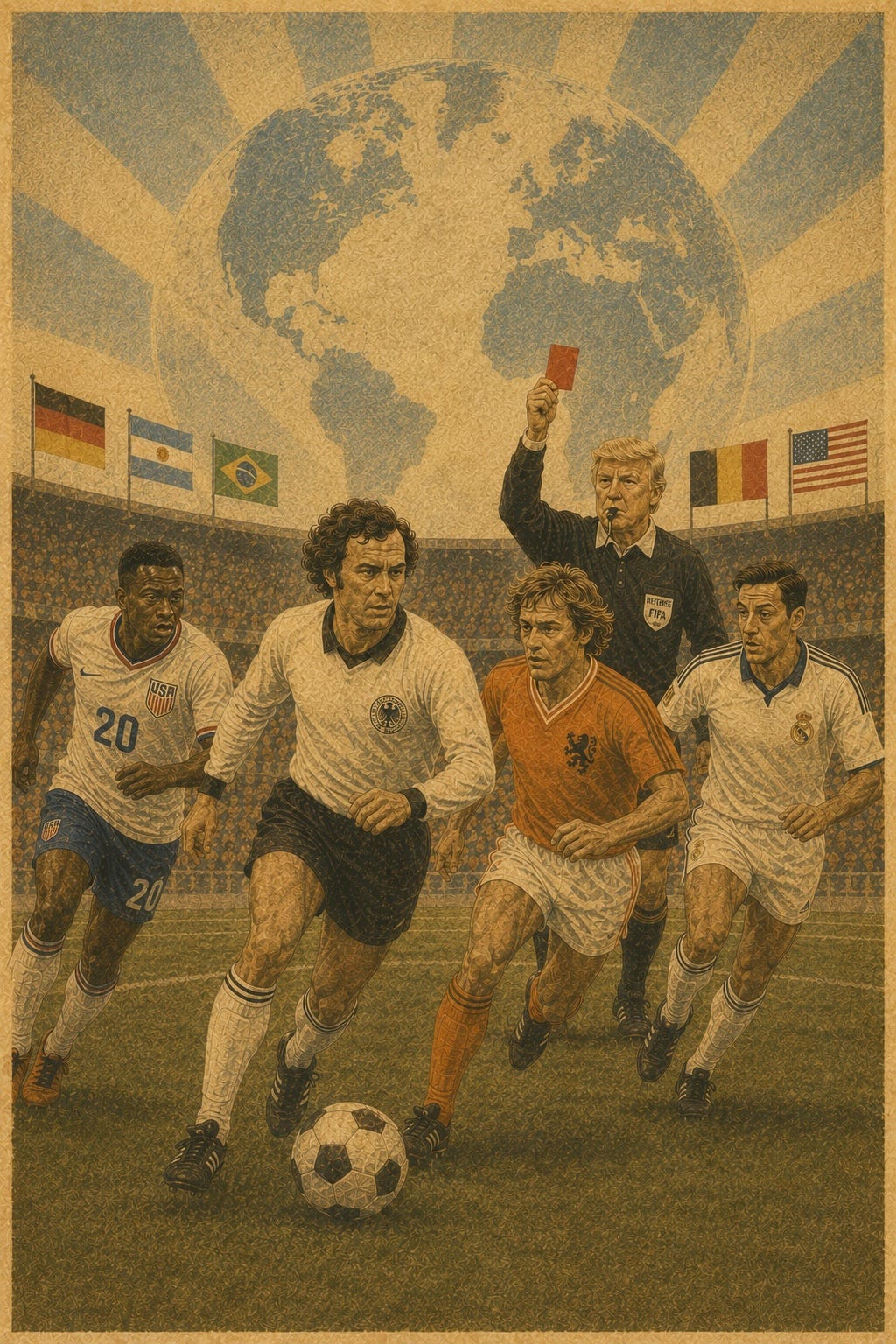
When I started watching soccer in the early 1970s, the World Cup was a spectacle of nation states competing against each other with players born and bred in distinctive national traditions. In 1974, the first World Cup I remember, West Germany won against the Netherland 2-1, with a squad composed exclusively of players who were employed in the Bundesliga. The Dutch squad was similar, with only two players playing for neighboring Belgium and one, Johan Cruyff, for FC Barcelona. The latter was seen as a rare anomaly. Four years later, Argentina took the title by beating the Netherlands 3-1 in extra time with an entirely domestic squad except for one player, employed by Valencia CF.
That year, Franz Beckenbauer, who had led his team to its World Cup win four years earlier, was absent from the West German squad because he had made the highly unusual decision to move to New York to play for Cosmos. Beckenbauer was in his early 30s, so still in his prime, but the move to New York had placed him somehow beyond the pale. The only expected and acceptable reason to move abroad, at least among self-respecting soccer nations, was as a kind of early retirement, when a player could no longer play competitively at home. And when players in their prime did move internationally, their movements were determined by cultural and linguistic affinities, as when players moved from the Netherlands to Belgium or from Latin America to Spain.
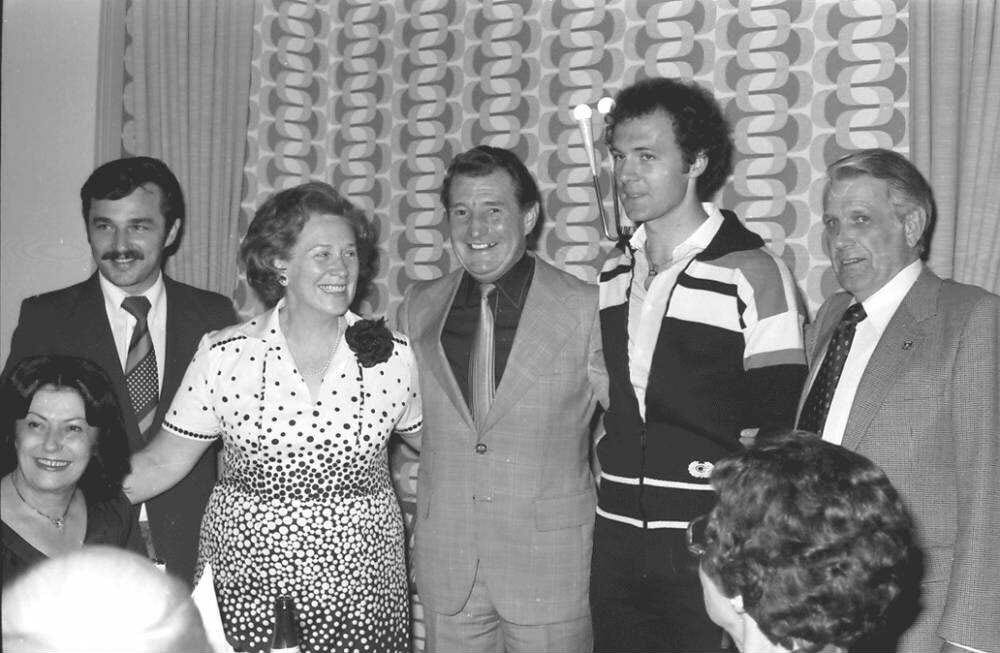
During the 80s, the number of players employed abroad crept up, though very unevenly. Most larger soccer nations, such as Brazil, Argentina, Italy, England, Spain and West Germany continued to field teams composed almost exclusively of domestic players, while smaller nations, including Netherlands, Sweden, and Denmark, had more players based abroad. This meant that teams played different national styles. Italy played defensively, with rapid counterattacks. Argentina was possession-oriented and increasingly organized. England excelled at direct passing and crosses. West Germany used the attacking libero position pioneered by Beckenbauer, comparable perhaps to the quarterback in American football.
The reasons for this national organization were partly regulatory. Soccer was a highly protected market with foreign-player quotas. But it was also a cultural matter, with foreign travel more difficult and costly. This state of affairs continued into the early 90s. I remember when one of my favorite players, the diminutive Pierre Littbarski (5’6’’) moved to Japan in 1991, thus putting himself, as Beckenbauer had before him, somehow outside the game. Even though he had just won the 1990 World Cup in a 1-0 final against Argentina, moving to Japan meant he was soon phased out of the national team.
Then came the 1990s, the end of the Cold War, and deregulation. 1990 was the last Cold War World Cup, with the Berlin Wall having come down just nine months earlier. West Germany won that title three months before its reunification with East Germany, fielding, for the last time, a team composed entirely of West German players. Immediately upon reunification, leading East German players were integrated into the national squad. Spirits were high, not to say cocky, and many predicted that the combined forces of east and west would make German soccer invincible. What happened was the opposite. German soccer declined and had to be reconstituted in the late 90s and 2000s. Germany wouldn’t win again until 2014.
By then, the face of soccer had changed completely. In December of 1995, the European Court of Justice ruled in favor of Belgium player Jean-Marc Bosman’s claim that foreign-player quotas were illegal and that out-of-contract players should be able to move to another EU club without a transfer fee. The decision became a catalyst for globalizing soccer. I vaguely remember, sometime in the 90s, watching a German offensive player chatting on the field with his defending counterpart and realizing that they played for the same club. Their allegiance, I thought, must be divided since it was probably more important for them to remain on good terms with their colleagues than to play for their national team. It was a glimpse into the future of soccer as a truly global game. It wasn’t just that the number of players employed by foreign clubs increased; the types of foreign assignments changed as well in that the movements of international players were no longer shaped by cultural and linguistic affinities, with English now serving as the lingua franca.
The other driver of change was also based on deregulation: the liberalization of television. When I was growing up, the World Cup was one of the few occasions when you could actually watch games on television; most other matches were not televised. You could follow soccer on the radio or watch weekly summaries, otherwise you had to go and watch a game in person. The liberalization of television in Europe, which happened unevenly from the mid-80s to the mid-90s, meant a sudden influx of money, fueling the transfer game we know today.
If one story of globalization was the international transfer of players, the other was immigration. Immigration shaped soccer at the World Cup level with a delayed effect, typically taking at least one generation to make itself felt on the field. European nations with former colonies such as England, France and Belgium had more immigrant players and had them earlier. Others, like Germany, remained largely white well into the late 1990s. It took until 2009 for a Turkish-German player, Mesut Özil, to make the national team--a third-generation Turkish German. While the pan-European transfer market created internationalization on a European level, immigration enabled an influx of players from outside Europe.

Soccer in America
What about America? I moved to the US in 1993 and drove cross-country with my brother during the 1994 World Cup, watching games in Motel 6 rooms located in stunning landscapes and strange small towns. I had been to the US for extended periods before, but I think of this World Cup-themed drive as the time when I really got to know America.
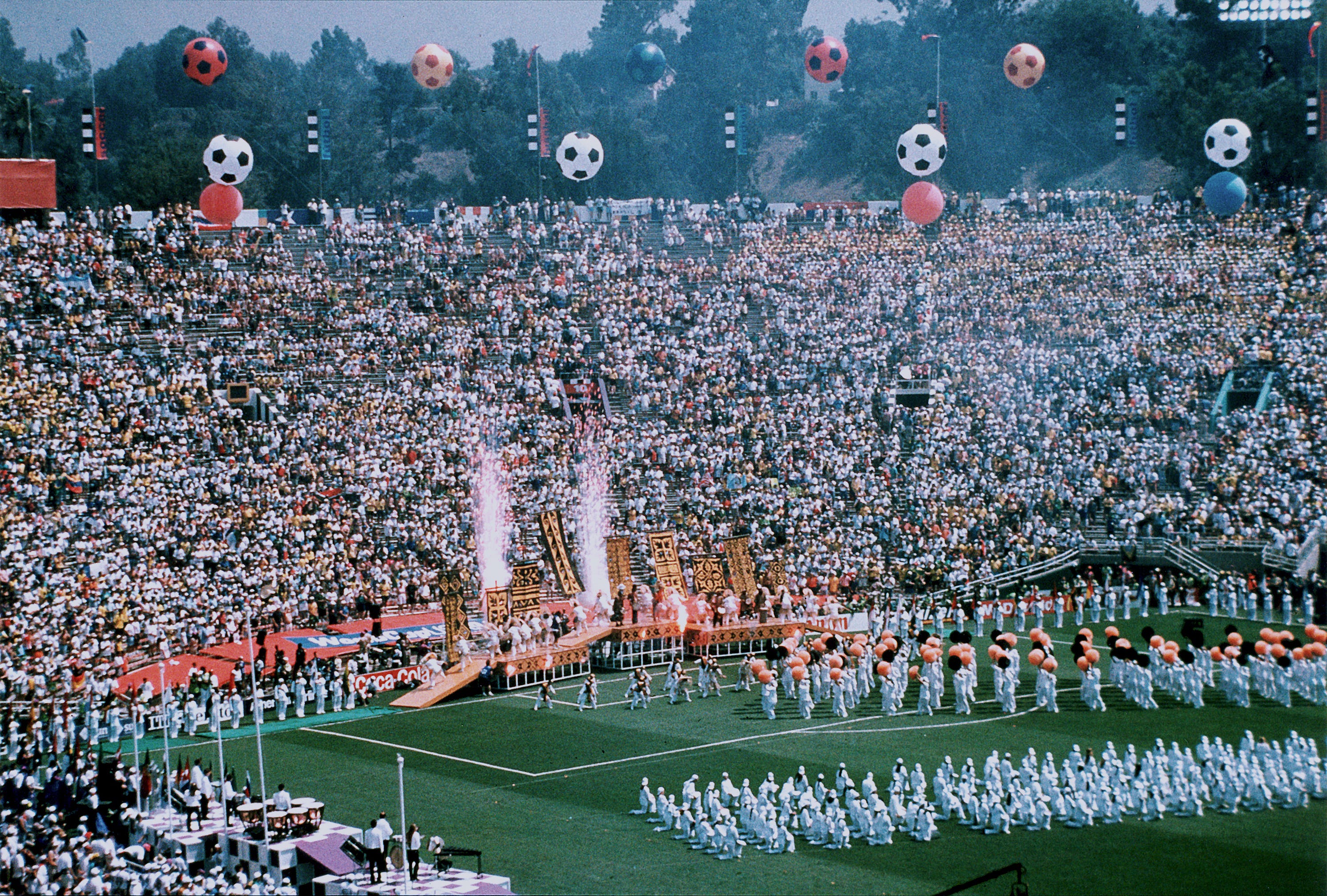
It was an America in which soccer played a minor role. US commentators didn’t know the game well and struggled to explain it to US audiences. Ever since, I have been rooting for soccer to make it big here. But soccer has been a difficult sell. In part this was because sport was and is a crowded field, but there have also been other problems with soccer in America. The longer I have lived here, the more I have come to see soccer through American eyes. The spectacle of rolling around the field pretending that you’ve been mortally wounded now seems embarrassing, rather than savvy, to me, and I’ve come to appreciate the near absence of these theatrics in women’s soccer. When soccer players pass the ball back and forth just to pass the time, I yearn for the forward movement of American football.
But the root of the problem is the low scoring nature of soccer, which has all kinds of consequences. Above all, it makes the outcome of a given game much more dependent on that one bad decision, that one mistake, from which it is near-impossible to recover. It also makes the outcome of the game much more dependent on the referee, since a penalty kick or a red card can have an outsized impact on the result. (The attempt to solve this with VAR, the video assistant referee, has been a disaster because it has not altered the basic nature of the game. It only resulted in more delays and the frustration of delayed or misguided jubilation.)
The most profound effect of low scoring, as others have observed, is that it requires players to face their own frailty and their exposure to external factors (such as referee calls) beyond their control. In other words, soccer is a tragic game. America, at least in its self-conception, does not accept this tragic view of life and believes in taking fate into your own hands. When Donald Trump lobbied FIFA to have an unfair red card for Bolagun rescinded, he wasn’t just being Donald Trump; he was also channeling an American objection to soccer’s tragic view of the world.
The State of the World, 2026
What does the 2026 World Cup say about the state of the world? Even though there may be signs that we’re living through an era of de-globalization, this World Cup tells the opposite story, one of ever-accelerating globalization. The number of players employed by foreign clubs stands at an all-time high of 72%. As for migration, about 24% of players were foreign-born, also an all-time high. Of Curaçao’s 26 players, 25 were foreign born. For Bosnia & Herzegovina, 15 out of 26. (On the other end of the spectrum, Brazil, Colombia, South Africa and Austria had no foreign-born players.) An even larger number of players were children or grandchildren of migrants. Famously, Folarin Balogun was able to play for the US only thanks to birthright citizenship, when his heavily-pregnant mother was barred, by the airline, from flying back to London, thus forced to give birth on US soil. It’s a reminder that changes to citizenship laws, especially in countries traditionally less open to immigrants, have further contributed to the globalization of national soccer teams.
The 2026 World Cup delivered a snapshot of global culture in another way as well: the relation of the US to the rest of the world in an era dominated by Donald Trump’s America First policies. One drama was regional, given that the World Cup was hosted not only by the US but also by Mexico and Canada, making it the first NAFTA World Cup. What made this especially poignant was that Trump suggested, while the World Cup was going on, he might not renew the revised NAFTA treaty (technically renamed USMCA), which he himself had renegotiated during his first term. But if soccer has anything to tell about the state of NAFTA, it’s that the treaty is in better shape than it may look, given that the NAFTA signatories pulled off this event without a hitch.
How about the rest of the world? Many visitors were surprised by the spontaneous welcome they received in the US. The most well-publicized scenes of fraternization happened in Boston, where Scottish fans decked out in kilts and bagpipes were enthusiastically adopted by Bostonians, who even took them to a baseball game at Fenway Park, to show them what a real American sport looks like. There were other, equally touching stories, such as Algerian fans being welcomed back to their base in Lawrence, Kansas, with an elaborate show of fireworks.
From a perspective of soft power, the world cup couldn’t have come at a better time for the US (see an earlier essay on soft power here). I’ve been struck, when traveling through Europe, by the widespread perception that the US has become something close to a failed (or rogue) state. The World Cup, happily coinciding with the 250th anniversary of the founding of the United States, was an occasion to show that such perceptions are exaggerated.
As was the case with every World Cup since the 1994 American games, this one has again increased the status of soccer in the US. Does this mean Americans are ready to embrace this global game with its tragic view of life? Only time will tell.
Dear Professor Puchner,
Your analysis of football’s evolution – as always, both illuminating and thought-provoking – has inspired me to project these trends into the near and more distant future. Naturally, the probability of these scenarios decreases as one moves down the list, but as you know, even the improbable has a way of becoming reality.
1. The next step might be a further expansion of the pool of participants, perhaps including non-sovereign regions or cities.
2. This could be followed by a gradual reduction in the residency requirement for national team eligibility – from five years to four, then three, or even its outright elimination, as dual (or multiple) nationalities become the norm.
3. In a more speculative, yet not impossible, turn, investors might exploit the smallest states to acquire entire national teams, turning them into global franchises.
How far would you be willing to follow these – admittedly wild – speculations?
With best regards from a non-football expert who, in 1974, sat in front of a television in Schalke at the age of 11, watching the matches with the same fascination that your essays now inspire in me,
Christoph Holtwiesche
Well said …. “In other words, soccer is a tragic game. America, at least in its self-conception, does not accept this tragic view of life and believes in taking fate into your own hands.”