
False Dilemmas
Is America Suffering from a Logical Fallacy?

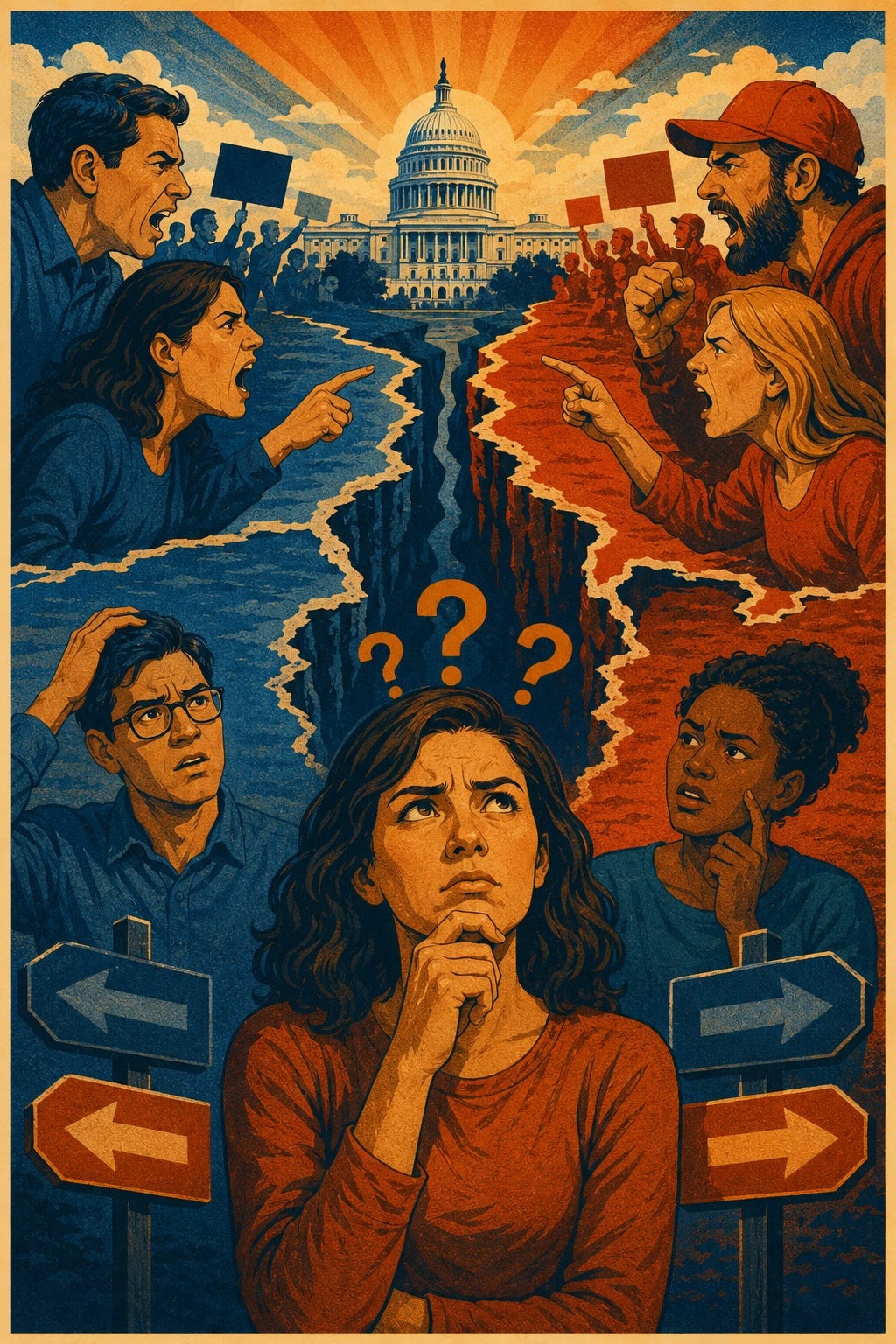
The more I teach logic in college writing classes, the more I see its failures out in the world. Take the tendency of labeling people snowflakes, soy boys, or groomers to question the integrity of their position. That’s a clear case of ad hominem, challenging the person making an argument rather than the argument itself. Or the rejection of compromise positions, such as background checks, out of fear that a small concession will inevitably lead to much more extreme outcomes, such as the outlawing of guns. This is the slippery slope fallacy, the fear that a single step in the wrong direction will lead to catastrophe. Or arguments against positions no one is actually arguing for. This is the straw man fallacy, caricaturing an opponent’s arguments in order to render them less strong.
A major problem in American political life is polarization. We have moved farther apart on key political issues such as immigration, abortion, tax policy or climate change. Many causes have been offered to explain this phenomenon: the geographic clustering of like-minded people, which reduces contact with people who think differently; the decline of civic associations, which further reduces opportunities to leave demographic bubbles; and social media algorithms that favor engagement, which ensures that posts inducing rage get preferred billing.
Logic points to an additional cause. We are living in a world shaped by the fallacy of the false dilemma. That is, complex realities are being reduced to two, and only two, positions.
But isn’t the logical diagnosis of polarization merely a way of describing the problem rather than identifying its root cause? If, for example, the true culprit is geographic sorting, vanishing civic organizations, or social media, won’t the solutions come from rectifying those causes? I suspect that this distinction between cause and symptom may be—you guessed it—a false dilemma. Political polarization is a complex phenomenon, of which faulty logic is one.
Describing polarization in terms of logic has several merits. First, it allows us to distill the problem more precisely. It enables us to see, for instance, that polarization dovetails with the two-party system, which forces us on election day to reduce complex reality into a binary choice. To be sure, the two-party system has existed for almost the entirety of US history (although it plays no role in the Constitution). But as long as each party functioned as a big tent containing multiple positions and as long as political culture allowed for cross-party initiatives, the two-party system worked reasonably well, leading to occasional realignments and even new parties. But when those practices disappear, the two-party system embeds a false dilemma into the structure of political life.
The false dilemma also allows us to understand another phenomenon: the linking of disparate political causes. Many people who are pro-religion are also against immigration, just as many who worry about the environment also are against AI. Many people who support Palestine also support gay rights, while many who are opposed to abortion are in favor of guns. But there is no obvious reason why these views should be linked. Yet increasingly, all these different political issues are lined up much more neatly than one would expect.
Progressives developed a term, intersectionality, to justify this phenomenon. Originally the term simply meant that different forms of disadvantage can be compounded, but over time it called for the linking of a whole array of social justice causes. But intersectionality is by no means limited to the left and can be found across the political spectrum. Either you buy this bundle of linked positions or that bundle; there is no other choice. From the point of view of logic, linking is the false dilemma squared. When disparate topics are linked within an already polarized world, it means that false dilemma thinking dominates not only each individual issue but all of them at once.
Logic is helpful in another way as well. Focusing on the other causes of polarization requires us to envision complex, collective solutions, such as changing housing policies, starting new civic organizations, keeping teenagers away from social media or founding new political parties. Each of these tasks seems daunting enough that this way of thinking about polarization can lead to despair. Focusing on logical fallacies, by contrast, reveals opportunities for immediate action. That’s because logical systems offer a training program for fighting against false dilemmas, a mental gym in which people can exercise the muscles they need to resist polarization. That’s what they were designed to do.
Logical Training from Around the World
The concept of the false dilemma is as old as logic itself, which means it’s been around for nearly 2500 years. At roughly the same time in history, systems of logical thought independently emerged in several regions of the world. They were developed specifically as a way to manage clashes in religions and worldviews. Logic emerged from conflict.
One of these logical systems was developed in ancient Greece, at a time when public life in Athens was divided between two groups: philosophers and sophists. In response, Aristotle developed a technique that would allow philosophers to debate their opponents more effectively. He noticed that many sophists offered their interlocutors false, artificial choices. Aristotle therefore sought to inoculate his followers against this practice by teaching them to pay attention to the very act of classification, to the ways we divide the world into categories. Such divisions can’t simply be posited; they must be challenged and grounded in reason. (The fact that we now use the term “sophist” pejoratively shows that Aristotle succeeded.)
In order to teach young people the tools of logic, he set up a school, called the Lyceum. In it he trained students to resist false dilemmas by showing, in many spheres of life, the importance of intermediary positions. Because his pedagogy involved arguing while taking long walks, his followers were called Peripatetics.
Another tradition of logic started in north India, when a prince, Siddhartha Gautama, began to challenge Hindu priests in public debates. From these challenges, Buddhism would emerge (starting in the 5th century BCE). Over time, Buddhists developed rules of logic aimed at avoiding common mistakes in reasoning. Some Buddhist philosophers, including Nagarjuna (c. 150-250 CE), developed a “four corner” logic. Instead of reducing logic to a binary, X and not-X, he added two more positions: both X and not-X; and neither X nor not-X. In this way, reasoning was restructured to prevent false dilemmas from becoming entrenched.
Like Aristotle, Buddhists understood the power of training. They developed monasteries, most prominently in Tibet, that specifically trained young monks in the art of debate. Instead of arguing while walking, as the Peripatetics did, Buddhist monks met every afternoon in the debating courtyard to practice their art.
In response to the Buddhist challenge, Hindu Brahmins responded with a logic system of their own. The result was the Nyaya Sutra, a treatise on logic and debate, likely from the second century BCE. It tried to establish common ground for constructive debates among different traditions, with particular attention to sources and evidence. It recommends that debaters quote from scripture rather than hearsay and to rely on experts only if they have no reason to lie. But the Nyaya tradition also worries about false dilemmas, which occur when you treat a position and its opposite as exhaustive even when, as is the case so often, there are many more possible positions one might take.
All three of these logical systems were widely adopted. Buddhist traditions of logic traveled from India to Tibet and onto China, Korea, and Japan. The Sanskrit Nyaya tradition spread around the Indian subcontinent and into Indochina. Both may also have exerted some influence westward, to the Middle East and even Greece, although that vector of influence is harder to prove. Aristotle’s logic, for its part, went east. Forgotten in Europe, it would become enormously influential in medieval Baghdad, contributing to the flourishing of an Islamic debate tradition. Only in the 12th and 13th centuries would many parts of Aristotle’s logic return to Europe, establishing a debate tradition in European universities—and then to America. Until the late 18th century, graduates of Harvard University had to defend their thesis in public, as part of commencement exercises. The language of debate was, naturally, Latin. (Those who watched Harvard’s commencement exercise last week might have noticed the Latin Address, sole remnant of this grand tradition.)
Much has changed since then, of course. Students aren’t expected to know Latin anymore, logic is now treated as a subspecialty of philosophy, and debate has become an extracurricular. But the tradition of logical debate is a tradition worth reviving. I’m not suggesting we sequester students in Tibetan monasteries and require them to learn four-corner logic. But I do believe that logic, that art developed in times of conflict, is a helpful tool for managing the conflicts of our own day.
While other causes of polarization, such as housing policy, social media, and the two-party system, seem impossible to change, logic is something each of us can practice in everyday life. We may be forced to make binary choices on election day, but on all other days of the year we can resist the false dilemmas that surround us. When confronted with a false dilemma, we can train ourselves to think of Aristotle and his campaign to question the wisdom of a given binary, or ponder the ways in which neither position is necessarily true, as Buddhist four-corner logic suggests. Or, when confronted with evidence such as a statistic or graph, we can wonder about its source and validity, as the Nyaya Sutra demands.
Given how deeply false dilemmas have shaped our thinking, it’s probably best to start our personal training programs with smaller, less consequential matters. Is it better to read a physical book or an e-book? Well, that depends on many factors, and sometimes an audiobook is the solution. Should schools teach facts or critical thinking? Well, you actually need to know some facts to engage in critical thinking. Only in a second step can we hope to carry the work of de-linking to the hot-button issues of our day, picking apart different strands and weaving them into new patterns.
Logic can’t solve all the problems that beset our world, including those that cause polarization. But it can train us to identify and resist false dilemmas when we encounter them, as we invariably will.
Editor’s Note (June 7, 2026): This essay has been updated to clarify the discussion of ad hominem arguments. The phrase “to question the integrity of their position” was added to make clear that the fallacy lies not in the use of labels themselves, but in using such labels as a substitute for engaging with an argument.
Thanks for reading In Practice! Subscribe for free to receive new posts and support my work.
Thanks so much. I think I started doing it after finding that my students--and I myself as well--kept running into these logical problems. At this point, I remembers having suffered through a logic course back in college (I almost failed it). Right now, I don't teach logic in regular literature classes, though I have half a mind to start doing it, but only in more explicit writing classes. For me, it's part of the craft of writing, which I think is closely aligned to the craft of thinking.
Thank you, Martin, for a sane cease fire appeal in terms of logic even if ethics no longer moves people. I'd like to join your reminder that earlier periods had useful practices for coexistence. I incorporate a few in the Pre-Texts pedagogy protocol. One ancestral practice is to sit in circles for meetings rather than rows. The difference seems too simple to be radical, but the effect is quite profound. Just to give one recent example, the president of a major international academic association was about to confront objections or rejections of accords that had been reached under his leadership. After several sessions of Pre-Texts, at the decisive meeting he insisted that the participants sit in a circle, visible and vlnerable to one another. The issues were resolved, he informed me, with surprising efficiency and relief.
So, along with your several excellent recommendations, I would add the merits of a pedagogy that makes light work of the Montessori Method and that learns from ancient Athens to identify school with leisure. Philosophers surely had fun with their desciples as they achieved logical patterns of thinking.